Dominique Fils-Aimé
Live at the Montréal International Jazz Festival
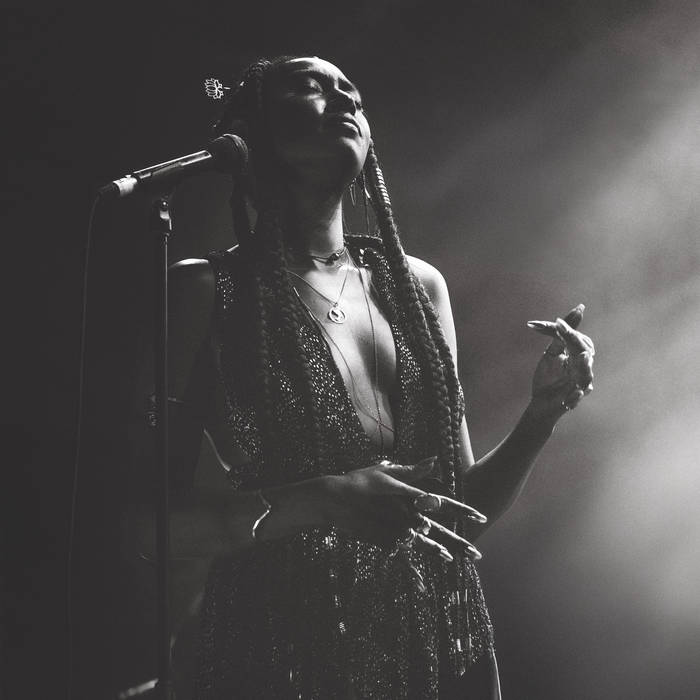
Recorded in Montréal in June 2024, Dominique Fils-Aimé’s first live album does more than preserve a set. Familiar songs are stretched, joined together and rearranged until the concert starts to feel like a separate work in its own right.
There is a difference between recording a concert and making a live album. Live at the Montréal International Jazz Festival lands firmly in the second camp. Dominique Fils-Aimé and her band use the stage to pull at songs from across her catalogue, sometimes changing their shape completely rather than reproducing the studio versions.
The original version of this review talked a lot about transformation in broad terms. Listening to the album as a full set, the more interesting story is in the details: where a groove is allowed to run longer, where two songs are pushed together, or where the backing voices change the weight of a familiar line. That makes a track-by-track approach a better fit for the record.
Tracklist
- Introduction
- My Mind At Ease
- Birds / While We Wait
- Mind Made Up
- Grow Mama Grow
- Tall Lion Down
- Love Take Over
- Big Man / Freedom
- Fall And All / Old Love
- To Walk Away / Give Me A Reason
- Cheers To New Beginnings
- Moi je t’aime
- Joy River
- Our Roots Run Deep
How does the set unfold track by track?
Introduction
The opening is deliberately patient. Fils-Aimé begins quietly and lets the arrangement build a piece at a time, including an excerpt from “Feeling Good”. It immediately establishes that this is not going to be a straight run through familiar songs. Space matters as much as volume.
My Mind At Ease
The first full song moves into a slower, blues-heavy arrangement, with wah-wah guitar and backing voices giving it more weight than the studio version. After the restraint of the introduction, it feels grounded and slightly rougher around the edges in a way that suits the live setting.
Birds / While We Wait
This is the first clear example of the album treating songs as material rather than fixed objects. The two pieces are joined across nearly eight minutes, with the rhythm section holding the tension underneath Fils-Aimé and the backing singers. The shift into “While We Wait” feels natural rather than stitched together.
Mind Made Up
After the longer medley, “Mind Made Up” is more contained. Its softer blues feel gives the set some breathing room and puts the focus back on the vocal performance. The album is strongest when it understands when not to push.
Grow Mama Grow
“Grow Mama Grow” brings more bite into the band, pulling together blues, rock and R&B without making the arrangement feel overloaded. It is compact and direct, which makes it an effective bridge into the more rhythmic centre of the set.
Tall Lion Down
This is where the record noticeably loosens up. The groove is more playful and physical, and the live arrangement gives the band room to lean into that movement. It is one of the moments where the difference between the concert version and simply replaying the original song is easiest to hear.
Love Take Over
“Love Take Over” follows naturally, but with a brighter sense of release. Caribbean and Afro-Cuban rhythmic touches push it forward while Fils-Aimé and the backing singers turn the chorus into something much more communal. The joy here feels earned because the set has taken its time getting to it.
Big Man / Freedom
The mood changes again. Reggae elements in “Big Man” give way to the darker, gospel-leaning atmosphere of “Freedom”, and the transition is one of the clearest reminders that the sequencing has been thought about as carefully as the individual performances.
Fall And All / Old Love
This remains the album’s standout passage. “Fall And All” is pared back enough for every vocal shift to register, with piano, organ and percussion leaving plenty of air around Fils-Aimé. When it moves into “Old Love”, the arrangement expands rather than breaking the spell. The crowd is present on the recording, but the performance never needs to shout over them.
To Walk Away / Give Me A Reason
Another paired performance reinforces one of the album’s best ideas: the catalogue is allowed to overlap. Rather than placing a hard stop between every song, the set keeps finding connections between them. By this point that approach feels like part of the album’s language rather than a novelty.
Cheers To New Beginnings
The title is fitting for a record so interested in revisiting older material without treating it as finished. The performance sits comfortably in the latter half of the set, where the arrangements feel less like demonstrations of what can be changed and more like the band simply inhabiting the new versions.
Moi je t’aime
At just over three minutes, “Moi je t’aime” is one of the shortest tracks here. That brevity works in its favour. After several longer combinations and extended arrangements, it provides a compact pause before the album moves into its closing pair.
Joy River
“Joy River” draws openly on gospel, and the backing voices become especially important. What could have been a conventional late-set lift instead feels connected to the record’s wider interest in repetition, call-and-response and collective performance.
Our Roots Run Deep
The closer gathers several strands heard across the set, including blues, gospel and Caribbean and West African influences. It is a bigger finish than the album’s quiet opening, but it does not feel disconnected from it. The journey from restraint to release is what gives the set its shape.
What does the live album add?
The strongest argument for Live at the Montréal International Jazz Festival is simple: these versions have a reason to exist. The medleys are not there to save time, the improvisation does not feel bolted on, and the backing singers are used as part of the arrangements rather than decoration.
That does not mean every track needs to be dramatically reinvented. Some of the quieter moments work because the changes are small. Across the full 14 tracks, the balance between restraint and release keeps the record moving without turning the concert into a showcase of technical tricks.
Most importantly, it sounds like a live album. You hear musicians reacting to one another and an artist comfortable enough with her own catalogue to pull it apart in public. That is far more interesting than a polished souvenir of a night that has already happened.
Listen to the album ↗Final thoughts
Live at the Montréal International Jazz Festival works because it keeps the character of Fils-Aimé’s songs while refusing to freeze them in place. The best stretches, particularly “Fall And All / Old Love”, show how much can change when the live arrangement is treated as part of the writing rather than an afterthought.

Editor. Gig-goer. Fantasy football tactician. London-based Executive Assistant by day, live music obsessive by night. Being a control freak? Very transferable skill.