
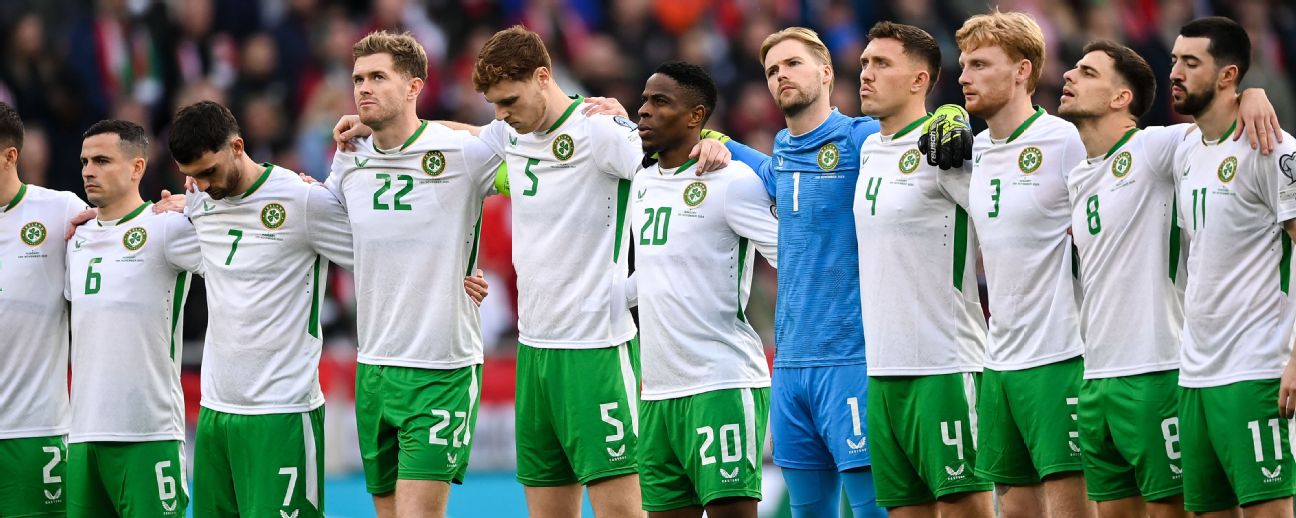
Every few years, Irish football fans go through the same cycle: hope builds as a young striker starts scoring for a club abroad, then the FAI calls. England sometimes calls too, and England usually wins.
That’s the story of Irish football in one paragraph, a tale of borrowed talent and missed chances, played out by a domestic game that spent decades scrapping for oxygen against Gaelic football and hurling. But there’s real life in the game right now too, and that’s worth digging into.
Why did football have to fight for its place in Ireland?
British soldiers and Scottish dock workers brought football to Belfast in the 1870s and 1880s, and the Irish Football Association formed there in 1880 to run the game across the whole island. That arrangement didn’t survive the political split between unionist Belfast and nationalist Dublin, and in 1921, the same year partition split Ireland itself, the sport split too, as Leinster clubs broke away and formed the Football Association of Ireland. From then on the island had two associations, two leagues and eventually two international teams, and reunification attempts failed in the 1920s, the 30s, the 70s and the 80s.
But partition wasn’t the biggest obstacle to football’s popularity in independent Ireland. The GAA was.
The Gaelic Athletic Association banned foreign games in 1886, tightened that ban in 1905, and enforced it for 66 years, so members caught playing, or even watching, football, rugby, cricket or hockey faced suspension, and vigilance committees turned up at matches specifically to catch offenders. In 1938, the GAA even stripped its own patron, President Douglas Hyde, of that role simply because he attended a football international at Dalymount Park.
The GAA didn’t drop the ban until 1971, at a congress in Belfast, and by then Gaelic football and hurling already had a five-decade head start in Irish schools, clubs and county pride. Football never closed that gap, which is why GAA games still routinely outdraw League of Ireland fixtures for crowds and coverage, and why county identity runs deeper in Irish sport than club loyalty in football ever managed.
How did Jack Charlton turn a loophole into a golden era?
Ireland’s answer to a small talent pool was FIFA’s grandparent rule, which lets a player represent any country where a parent or grandparent was born, and Jack Charlton, appointed Ireland manager in 1986, used that rule better than anyone before or since.
He went scouting through England’s lower leagues and top flight, hunting down players with an Irish granny or grandad wherever they’d actually been born and raised, and the pattern repeated itself over and over. John Aldridge got in through a great-grandmother from Athlone, Ray Houghton, Andy Townsend, Kevin Sheedy and Mick McCarthy all found their own route through the family tree, and between them they became the spine of Charlton’s Ireland. Some qualified more tenuously than others, though, like Cascarino, who was eligible only through adoptive grandparents he had no actual blood tie to.
It worked spectacularly. Ireland reached a first major tournament, Euro 88, and beat England 1-0 thanks to a Ray Houghton header, then two years later, at Italia 90, reached the World Cup quarter-finals, still the country’s best finish, before beating Italy in New York in 1994 and reaching the last 16 again.
That golden run gave Ireland a template: find talent through the diaspora, then punch above what a country of five million should manage.
When did the same trick start working against Ireland?
The granny rule cuts both ways, and eventually it cut Ireland deep, as Jack Grealish and Declan Rice make painfully clear.
Grealish came through Ireland’s underage system and played for the under-21s before switching to England in 2021, while Rice actually won three senior caps for Ireland, all in friendlies, under Martin O’Neill in 2018, before FIFA approved his own switch to England the following year. Both are now full England internationals, with Rice a regular starter.
Here’s the part that stings: until 2020, FIFA only let a player switch association if they hadn’t played a competitive senior match for their original country, and since friendlies didn’t count, England could watch a player’s form in Ireland’s shirt, wait, then swoop in the moment it suited them, and the player never got tied down by a single competitive cap.
Martin O’Neill later admitted there was never really a contest for Rice or Grealish, since both were born and raised in England and leaned toward the country of their birth the moment England came calling. FIFA tightened the rule in 2020, capping the switch window at three caps and age 21, but for that generation the damage was already done, and Ireland had effectively developed two Premier League and England internationals for free, only to watch them walk.
Rice and Grealish aren’t isolated cases either, since Ireland has fielded England-born players for decades, stretching from Aldridge and Cascarino right through to current squad members like Finn Azaz and Josh Cullen. The system that built the Charlton era never went away. It just stopped guaranteeing loyalty.
Is the League of Ireland finally building something that can show up?
For years, the League of Ireland was an afterthought, playing second fiddle to the GAA and second fiddle again to the Premier League on Irish TV screens, but that’s changing now, and the numbers back it up.
League of Ireland attendances broke one million for the first time in 2024, then rose again in 2025 to past 1.1 million, helped by Shamrock Rovers and Shelbourne both reaching the league stages of European competition, while the Premier Division alone drew 683,208 fans, up 8% on the year before. The opening weekend derby between Bohemians and Shamrock Rovers moved to the Aviva Stadium and pulled in 33,208 supporters, the biggest League of Ireland crowd in nearly 80 years.
Government money is finally following the interest: Budget 2026 handed the FAI €3 million for League of Ireland academy development, while clubs including Bohemians, Shelbourne and Galway United have applied for a combined €80 million in infrastructure grants. Facilities still lag behind demand, and Dundalk fans even had to crowdfund their own floodlight repairs in 2025, but the direction of travel is clear, since a stronger domestic league means more homegrown players who never face a choice of country in the first place.
What highs can Ireland actually point to?
Between the Charlton years and now, Ireland has picked up real moments worth remembering, from Robbie Keane dragging the team into the last 16 of the 2002 World Cup with a last-gasp equaliser against Germany, to Giovanni Trapattoni getting Ireland to Euro 2012, even if the tournament itself was grim to watch, right through to Martin O’Neill’s side beating Italy at Euro 2016 to reach the knockout stages, a night that remains one of the country’s proudest in years.
Then came a long, joyless stretch, as Ireland missed the 2018 and 2022 World Cups, plus Euro 2020 and Euro 2024, cycling through managers without ever settling on a squad or a style.
How are the women doing by comparison?
While the men’s team keeps hunting for a tournament breakthrough, the women’s side already found one, reaching their first ever major tournament, the 2023 World Cup, under Vera Pauw, where Katie McCabe scored Ireland’s first ever World Cup goal, an Olimpico direct from the corner flag against Canada. Ireland lost all three group games and went home early, but getting there mattered more than the scoreline.
The team built that run on a decade of steady growth rather than a single golden generation. Women’s football in Ireland only formalised in 1973, and for years the FAI barely funded it, while players like Denise O’Sullivan and Louise Quinn came up the same way, playing club football in Ireland before moving abroad for professional deals. That grassroots patience is starting to pay off.
Carla Ward took over as manager in January 2025, and under her Ireland pushed into League A of European qualifying, the toughest tier in the system, taking on France, the Netherlands and Poland. Ireland won three of six games and finished third, still good enough for a seeded play-off spot at the 2027 World Cup in Brazil, and they now face Kazakhstan in a play-off semi-final, then possibly Belgium or Poland for a place at the finals.
Here’s the real comparison: the men’s team hasn’t reached a World Cup since 2002, while the women’s team could get there twice in a row, and even though funding gaps and media coverage still separate the two sides, that results gap tells its own story.
Does the men’s squad give real reason to believe?
Heimir Hallgrímsson spent 2025 clawing back some credibility for Ireland. Troy Parrott, who completed a permanent move to AZ Alkmaar from Tottenham in 2024 after a productive loan spell at Excelsior, scored five goals across wins over Portugal and Hungary in November. He kept scoring in the Eredivisie too, racking up 27 goals in 39 games by March 2026, while Evan Ferguson found form again at AS Roma before an ankle injury derailed his season. That striking pairing dragged Ireland into a World Cup play-off against Czechia, in Prague, in March 2026.
Ireland stormed into a 2-0 lead in normal time, only for Czechia to claw it back to 2-2 and send the game to penalties, where Ireland led 3-2 in the shootout before losing 4-3. It hurt, but this wasn’t the toothless Ireland of recent tournaments, since this was a team that took a European nation to the wire on their own turf.
What matters most now is who’s coming through: Hallgrímsson has already blooded teenagers Mason Melia and Jaden Umeh alongside Parrott, while a batch of League of Ireland players, Shamrock Rovers’ Ed McGinty and Adam Brennan among them, are getting genuine senior looks too. Keep growing the domestic game at the rate it’s grown since 2023, and fewer of Ireland’s best will need a granny and a getaway plan, because they’ll already be home.
For Paul Cullen. RIP. The only person I knew with the same faith in the boys in green as me.
